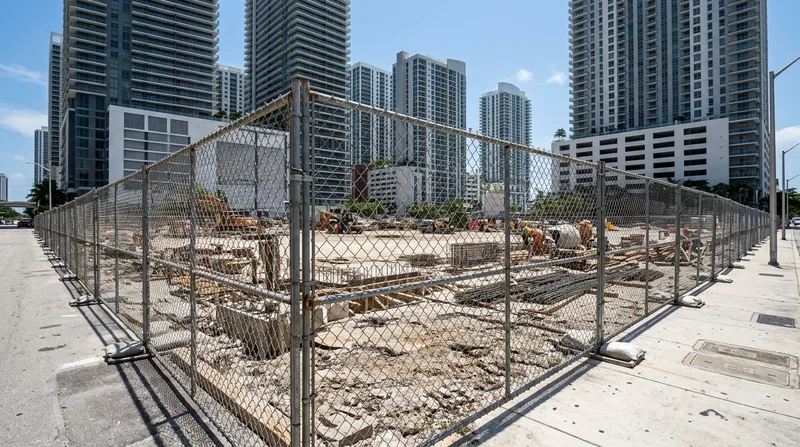




Commercial fence installation in Miami demands more than standard site barriers. Construction sites, event zones, and storm cleanup areas across Miami-Dade face sustained wind, salt spray, sandy soil that won't hold a post without concrete footings, and humidity that corrodes fasteners overnight. We set weighted and anchored temporary fencing panels that stand through Miami weather, and we install permanent commercial security barriers on sand that would shift under a lighter approach. Since 2011, we've built fencing for contractors, property managers, and municipalities across Miami, Hialeah, Coral Gables, Kendall, and beyond. This page explains what commercial and temporary fencing costs, how we install it, and what to look for when you need it fast.
Why Commercial and Temporary Fencing Matters in Miami's Construction and Storm Recovery
Miami's construction calendar runs year-round, but hurricane season from June through November can wipe out a site overnight. Temporary construction site fencing has to survive wind gusts that will topple a light-duty barrier, and it has to do it on sand that drains fast but holds anchor poorly. A panel weighted at the base or anchored with ground screws stays upright where a standard chain link fence leans or fails. Commercial security fencing, by contrast, lives on the property long-term and must resist salt air, daily UV, and the corrosion that attacks galvanized steel within months near the water. Aluminum and vinyl hold up where steel rusts. We've rebuilt fencing after named storms and installed new barriers to keep sites secure during months of construction.
- Temporary panels must be weighted or anchored to hold against Miami wind speeds without permanent footings.
- Construction site barriers protect workers and the public while keeping materials and equipment secure on the perimeter.
- Silt fence and erosion control barriers capture runoff on disturbed ground and comply with Florida stormwater rules.
- Commercial security fencing deters trespassing and theft on vacant properties, rental units, and industrial sites across Miami-Dade.
- Storm recovery fencing isolates hazard zones and protects cleanup operations on residential and commercial property.
Proper installation and anchoring mean your site stays secure whether the job runs three weeks or three months.
Key info: A construction site in Doral or Miami Beach exposed to coastal wind needs anchored or weighted panels rated for high wind. Ground-screw anchors work in sand, and weight bags distribute load across the footprint. We verify site conditions and wind exposure before we quote, because a barrier that holds in Kendall may fail on an exposed corner lot near the water.
For permit and regulatory guidance specific to your site, contact the Miami-Dade County Department of Regulatory and Economic Resources or your local city building department. Temporary fencing timelines and material requirements vary by jurisdiction and project scope.
How We Install Commercial and Temporary Fencing on Miami Sites
Our process starts with a site walk to assess wind exposure, soil conditions, and what the barrier has to do. On sandy soil, post footings go deeper and wider than code minimum because sand won't grip a standard-diameter post. We call Florida 811 before we dig, even on temporary installations, to locate buried utilities. For temporary barriers, we anchor panels with ground screws or weight them at the base. For permanent commercial fencing, we set posts in concrete, space them to code, and choose material (aluminum, vinyl, or galvanized chain link) based on corrosion risk and the barrier's job. We measure twice, set level, and brace against racking so the line stays straight through Miami's weather.
- We conduct a site assessment to evaluate wind exposure, soil type, and anchoring requirements before we begin.
- We call 811 to locate utilities before digging any post holes, as required by Florida law.
- We set posts in concrete footings sized for Miami sand and spacing to hold panel integrity under wind load.
- We anchor temporary panels with ground screws or weight bags rated for the expected wind speed.
- We brace and tension the installation to prevent racking and maintain a true line from corner to corner.
- We inspect the finished barrier for level, plumb, and secure attachment before we leave the site.
The result is a fence that holds its line and stays upright through the season. For larger commercial projects, we can also handle chain link fence installation with commercial-grade hardware and anti-sag bracing.
Local example: A construction site in Miami Gardens needed a 200-linear-foot temporary barrier for a six-month project. We installed ground-screw-anchored panels on sand, with the screws driven to resistance depth. After three months of summer thunderstorms and wind, the fence remained level and secure. The contractor extended the job timeline, and the barrier stayed in place without re-tensioning.
Commercial and Temporary Fencing Methods and Materials
| Approach | Description | Best for |
|---|---|---|
| Ground-screw-anchored panels | Temporary barriers held in place by helical anchors driven into sand without footings or concrete. | Short-term construction sites, events, and storm recovery zones on sandy soil. |
| Weighted base barriers | Freestanding panels with weight distributed across a base frame, no ground penetration required. | Rental property perimeters, temporary storage areas, and sites where digging is not permitted. |
| Permanent commercial chain link | Posts set in concrete footings, galvanized or vinyl-coated mesh, tension bands and stretcher bar hardware. | Long-term security fencing on industrial, commercial, and utility sites; durable and low-maintenance. |
| Aluminum and vinyl commercial fencing | Posts set in concrete, powder-coated aluminum or vinyl boards and rails, corrosion-resistant fasteners throughout. | Coastal properties and sites where salt spray or humidity will corrode steel; professional appearance. |
| Silt fence and erosion control | Temporary fabric barriers on posts, designed to slow runoff and capture sediment on construction sites. | Stormwater compliance on disturbed ground, required by most Miami-Dade development permits. |
Each method trades initial cost, durability, and ease of removal. We help you choose based on how long the barrier needs to stand and what the site conditions demand.
Commercial and Temporary Fencing Cost in Miami: What to Expect
Commercial and temporary fencing cost depends on the barrier type, material, length, anchoring method, and site conditions. A temporary construction fence with ground-screw anchors on sand runs lower per linear foot than permanent commercial security fencing with concrete footings and corrosion-resistant material. Aluminum and vinyl resist Miami's salt air but cost more upfront than galvanized steel. Silt fence for stormwater compliance is relatively low-cost but must be installed correctly to pass inspection. We provide a free site quote that includes soil assessment, wind exposure, and the anchoring or footing method we recommend for your site.
Start with a call to (786) 655-4173 for a free estimate. We assess the site, discuss timeline and material options, and give you a realistic budget before you commit. Most temporary installations run 3 to 8 weeks; permanent commercial fencing is sized for years of service. See our full pricing overview for ballpark figures by service type and material.
Factors that move the cost up include deeper footings in poor sand, longer perimeter, material choice (vinyl and aluminum cost more than galvanized chain link), and rush timelines. Getting 2 or 3 estimates is smart: you'll see the range and understand why one contractor is higher or lower. Cheap temporary fencing that fails mid-project costs more in the end.
What to Look for When Hiring Commercial and Temporary Fencing Contractors Near Me in Miami
Hiring the right contractor for commercial or temporary fencing means checking insurance, understanding local permitting rules, and verifying that the crew has done similar work. Here's what to verify before you sign.
- Confirm the contractor is fully insured with general liability and workers' compensation coverage, and ask for a certificate of insurance.
- Understand that fence installation licensing is set by county and municipality in Florida, not the state, so requirements vary across Miami-Dade and neighboring counties.
- Ask for references from recent commercial or temporary fencing jobs, and call at least two to ask about quality, timeline, and how the contractor handled changes.
- Verify that the contractor calls 811 before digging and understands local utility locate rules.
- Check whether your HOA or property deed has restrictions on fence material, height, or color, and confirm the contractor will work within those limits.
- Confirm that the contractor understands Miami-Dade stormwater rules if the job includes silt fence or erosion control.
- Get the estimate in writing, including material, labor, timeline, and what happens if the job takes longer than planned.
We've been installing commercial and temporary fencing in Miami since 2011 and hold all insurance and credentials required by Miami-Dade County. We're an AFA Member Installer with the American Fence Association. When you're ready to move forward, contact us for a free estimate and let us walk your site with you.
Commercial & Temporary Fencing in Miami: Pricing Guide
| Service | Price | Details |
|---|---|---|
| Temporary construction fence with ground-screw anchors | Starting at $12 per linear foot | Includes panel installation, ground-screw anchoring, and site inspection on sandy Miami soil |
| Weighted base temporary barriers | Starting at $18 per linear foot | Freestanding panels with weight distribution, no digging required, ideal for rental properties |
| Permanent commercial chain link fencing | Starting at $15 per linear foot | Posts set in concrete, galvanized or vinyl-coated mesh, tension hardware, anti-sag bracing included |
| Commercial aluminum or vinyl fencing | Starting at $28 per linear foot | Corrosion-resistant material rated for coastal salt air, powder-coated hardware, long-term durability |
| Silt fence and erosion control | Starting at $8 per linear foot | Temporary fabric barriers on posts for stormwater compliance on construction sites |
| Free site estimate | No charge | Response within 24 hours at (786) 655-4173, includes soil and wind assessment, no obligation |
Indicative pricing, the exact cost depends on square footage, finish, and site access. Free personalized estimate within 24h at (786) 655-4173.


