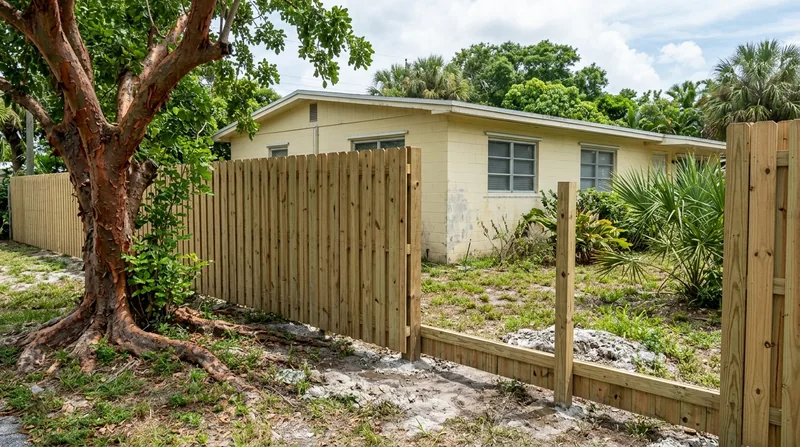




Privacy fence installation in Miami demands materials and methods built for salt air, high humidity, and sandy soil that won't hold a post the way clay does. Wood fencing here faces moisture at the ground line, corrosion from coastal spray, and the constant pressure of the water table. We install and repair wood and privacy fences across Miami-Dade County, working from the ground up with posts set deep in concrete, choosing species and fasteners that stand up to the climate, and often steering homeowners toward vinyl or aluminum alternatives when the long-term math favors them. Since 2011, we have built fences that last in one of the toughest climates in the continental US.
Why Wood and Privacy Fencing Matters in Miami's Climate
Wood fencing in Miami fights three enemies from day one: moisture wicking up from the sandy soil, salt spray that attacks fasteners and galvanizing, and the year-round humidity that keeps wood damp even in the dry season. Posts set in shallow holes or tamped earth fail within five to seven years. Privacy fences, which rely on close-spaced pickets or board-on-board construction, trap moisture between the boards and accelerate rot at the ground line. The right installation method, material choice, and maintenance plan make the difference between a fence that fails in half a decade and one that serves twenty years or more.
- Posts must be set in concrete at least 30 inches deep to anchor against sand and moisture.
- Pressure-treated pine or cedar posts and rails resist rot longer than untreated wood but still require monitoring.
- Galvanized or stainless steel fasteners prevent rust that bleeds into the wood and accelerates failure.
- Board-on-board construction allows air circulation between boards and reduces moisture trapping.
- Six-foot privacy fences are common in Miami, but setback and height rules vary by city and HOA.
These details separate a fence that lasts from one that becomes a repair project within a few years.
Key info: Miami-Dade and cities like Coral Gables, Kendall, and Homestead have different setback and height requirements. Check with your local building department or HOA before you order materials. Permits are required in some jurisdictions and not others, and deed restrictions often govern what you can build. Miami-Dade Building Department can clarify the rules for your address.
How We Install Wood and Privacy Fences in Miami: The Right Way
A solid privacy fence starts below the ground. We call out an 811 utility locate before we dig a single hole, mark the property line from your survey or your own identification, and set posts in concrete rather than tamping them into sand. The concrete collar extends above grade and slopes away from the post to shed water. Rails are fastened with stainless or hot-dipped galvanized fasteners, pickets are spaced and aligned for wind load, and the entire frame is squared and braced before the first board goes on. In Miami's sandy soil, this foundation work is not optional.
- We request or verify your property survey and install on the line you identify, never on an assumed or estimated boundary.
- Posts are set in concrete 30 to 36 inches deep, with the concrete collar sloped away from the post to drain water.
- Rails and stringers are fastened with galvanized or stainless hardware rated for coastal environments.
- Pickets are installed side-by-side or board-on-board depending on your privacy goal and budget.
- The frame is braced and squared before installation, and final alignment is checked with a level and string line.
This method costs more upfront but eliminates the post replacement that plagues fences set in sand without proper concrete footings.
Example in Miami: A 6-foot cedar privacy fence in a backyard in Palmetto Bay or Miami Lakes typically spans 80 to 150 linear feet. Posts go every 6 feet, which means 14 to 25 posts set in concrete. In sandy soil with a high water table, that concrete work is the difference between a fence that fails in five years and one that lasts twenty.
For more information on how we handle fence repair and post replacement when moisture or impact damage occurs, see our fence post repair page.
| Approach | Description | Best for |
|---|---|---|
| Pressure-Treated Pine | Posts and rails treated with copper-based preservative, resistant to rot and termites, lighter color than cedar, ages to gray. | Budget-conscious installations where appearance is secondary to durability and cost. |
| Cedar | Natural rot resistance from oils in the wood, warm reddish color, requires regular staining to maintain appearance, more expensive than pressure-treated. | High-visibility areas where curb appeal matters and the homeowner commits to maintenance staining every 2 to 3 years. |
| Board-on-Board | Pickets overlap on opposite sides of the rails, creating privacy from both directions and allowing air circulation to reduce moisture trapping. | Miami installations where humidity and salt air are factors, or where you need privacy without a solid wall that traps rain. |
| Concrete Post Setting | Posts anchored in concrete rather than tamped earth, essential in sandy soil and high water table conditions. | Every fence in Miami. Sand alone cannot hold a post against wind, settlement, and moisture. Concrete is not optional. |
Wood and Privacy Fence Installation Cost in Miami: What to Expect
Wood privacy fence installation in Miami runs from $32 per linear foot as a starting point for pressure-treated pine with posts set in concrete and standard 6-foot height. Cedar costs more, board-on-board construction adds to the labor and material bill, and site conditions like poor access, existing structures close to the fence line, or the need to remove an old fence before building new all push the price up. A typical backyard fence of 120 linear feet might run $3,800 to $5,500 depending on material and existing site conditions. We always recommend getting 2 to 3 estimates so you can compare material quality, installation method, and the warranty or guarantee each contractor offers.
For a detailed pricing breakdown and to see how different materials and configurations affect the final cost, visit our pricing page. Every estimate we provide is free and comes with no obligation to book. Call us at (786) 655-4173 for a quick phone conversation or to schedule an on-site look.
Wood and Privacy Fence Installation Near Me: What to Look for When Hiring in Miami
Hiring the right fence contractor in Miami comes down to three things: understanding how the law treats fence work, verifying insurance and workers' compensation cover, and checking that the contractor knows local permitting and HOA rules. Florida has no statewide insured contractor class for fence installation. Fence licensing and permitting are set at the county or municipal level and differ from one jurisdiction to the next. Some projects above a certain dollar threshold require a licensed general contractor, but fence installation itself is not a separately licensed trade in Florida. What matters is that your contractor carries full general liability and workers' compensation insurance, can provide a certificate of insurance on request, and understands the specific rules for your city or HOA.
- Ask for proof of general liability and workers' compensation insurance before you sign a contract.
- Verify that the contractor understands local setback, height, and material rules for your city and HOA.
- Get at least two other estimates so you can compare labor, materials, and warranty terms side by side.
- Check references from recent work, and ask specifically about how the contractor handled problem soil, water table issues, or permit delays.
- Confirm that the contractor will call 811 for a utility locate before digging and will work from your existing survey or your identification of the property line.
A contractor who takes time to explain the ground conditions and the concrete footing work is worth the conversation. Cheap bids often mean shallow post holes and no concrete, which fail within five years in Miami's sandy soil.
Ready to move forward? Contact us for a free estimate, or call (786) 655-4173 for questions about your specific site or to discuss material options.
Wood & Privacy Fence Installation in Miami: Pricing Guide
| Service | Price | Details |
|---|---|---|
| Pressure-Treated Pine Privacy Fence | Starting at $32/ft | Posts set in concrete, standard 6-foot height, includes labor and materials for a durable baseline installation |
| Cedar Privacy Fence | Starting at $42/ft | Natural rot-resistant wood with warm appearance, posts in concrete, higher material cost than pressure-treated pine |
| Board-on-Board Installation | Add $8 to $12/ft | Overlapping pickets on both sides of rails improve airflow and reduce moisture trapping in Miami's humid climate |
| Fence Removal and Replacement | On estimate | Removal, disposal, and new installation require site visit to assess debris volume and access for removal equipment |
| Free Estimate | No cost, no obligation | Response within 24 hours at (786) 655-4173 with a walkthrough and material options tailored to your site |
Indicative pricing, the exact cost depends on square footage, finish, and site access. Free personalized estimate within 24h at (786) 655-4173.


